

What Counts as a Pre-Existing Condition? (And Why Honesty is the Best Policy)

Written by: Sarah Findlay Travel Insurance Expert

Reviewed by: Dr Ellen Welch NHS GP and resident medical expert
Last updated: 17 September, 2026
Read time: 6 minutes
Quick Reads [TLDR]
A pre-existing condition is generally any medical issue for which you have had symptoms, treatment, medication, or a diagnosis within a set period (usually the last 2 to 5 years). This includes everything from chronic conditions like asthma to one-off events like a minor stroke that required surgery.
If you are wondering whether an old medical condition is still relevant, it is best to declare it. Answer the insurer’s medical questions fully, including any conditions currently under investigation. Read the insurer’s medical questions carefully and make sure you provide complete and accurate answers to each question.
The Big Three: What You Must Always Declare
The following examples highlight the main types of condition that must be declared. When in doubt, always disclose – it’s always better to declare and let the insurer assess relevance than to leave something out.
Chronic Conditions
These are long-term conditions that require ongoing management, medication, or monitoring.
Examples include (and are not limited to):
- Diabetes
- COPD (Chronic Obstructive Pulmonary Disease)
- Heart disease
- Crohn’s disease
- Asthma
Even if symptoms are well controlled, the condition still exists.
Historical Events
Some medical events must be declared for life or for many years after they occur, even if you feel fully recovered.
Examples include:
- Cancer (including remission)
- Heart attack
- Stroke
- Major surgery related to serious illness
These are considered significant medical history and may affect future risk assessment.
The Hidden Issues
Mental health conditions are one of the most commonly overlooked areas, but they are just as important as physical conditions.
Examples include:
- Anxiety
- Depression
- PTSD
- Stress-related disorders requiring treatment or medication
If you’ve received medication, therapy, or GP support, it must be included in your medical declaration.

The Forgotten Conditions
Some of the most commonly missed disclosures aren’t dramatic; they’re everyday health issues that people often forget need disclosing on their medical declaration.
Joint Pain
Back pain, knee injuries, arthritis, or physiotherapy appointments from the last two years should always be declared, even if symptoms have improved.
High Cholesterol
If you take medication or have been diagnosed, it is still a pre-existing condition, even if you feel perfectly healthy.
Pending Tests
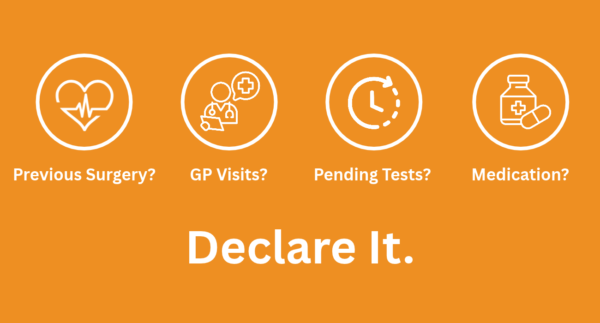
If you’re waiting for a scan, test results, or a specialist appointment, you must declare the condition.
Undiagnosed Symptoms
If there is no diagnosis yet, there may be no condition to screen and cover may not be available.
Contraception and HRT
Many people take contraception or hormone replacement therapy (HRT) routinely and may not think to include these when declaring their medical history. If you take contraception solely to prevent pregnancy and have no underlying medical condition, you do not need to declare it for medical screening. However, if contraception is being used to treat a medical condition, such as acne, the underlying condition must be declared and screened. HRT should also be declared where it is being used to treat a medical condition.
Insurers need the full picture, not just confirmed conditions.
Why Honesty is the Only Policy
It can be tempting to “simplify” your medical history when applying for travel insurance, especially if you feel fine. But this is where problems arise.
The Reality Check
If you make a claim, for example, for a broken leg abroad, the insurer may review your medical records. If they discover an undeclared condition (such as osteoporosis or a heart condition), they can legally void your entire policy.
That means:
- Your claim may be rejected
- Even unrelated injuries may not be covered
- You could be left paying the full cost of treatment yourself
The Peace of Mind Angle
Being honest isn’t about increasing your premium; it’s about certainty.
You’re not just buying travel insurance paperwork. You’re buying the reassurance that if something goes wrong abroad, your insurer will stand by you.
That only works if they have the full truth from the start.
Frequently Asked Questions
Pregnancy itself is not typically considered a pre-existing condition. However, you must declare it if there are complications such as pre-eclampsia or gestational diabetes. You can find more information on our pregnancy travel insurance page.
Yes - you must notify us of any changes to your health or medical conditions before travelling which may incur an additional premium, dependent on the associated risk. Acceptance of cover must be confirmed in writing for any changes to be valid.
You must declare all existing medical conditions for each person to be insured on the policy.
An existing medical condition is any medical condition for which you have experienced symptoms, seen a medical practitioner, visited a hospital or clinic, or been prescribed medication for within the last 2 years, as well as any previous medical condition which could impact on your current health or lead to claim.
Our Expert Checklist for Understanding Pre-Existing Conditions
An existing medical condition is any medical condition for which you have experienced symptoms, seen a medical practitioner, visited a hospital or clinic, or been prescribed medication for within the last 2 years, as well as any previous medical condition which could impact on your current health or lead to claim.
- Medical conditions which are controlled or prevented by medication, such as blood pressure or cholesterol, need to be declared.
- If you decide to declare some existing medical conditions and not others your cover could be void.
- If you no longer have a medical condition, but have been to a doctor's surgery, clinic or hospital for a check-up or follow-up appointment in the last 2 years you must declare that condition.
- Where a medical procedure has resulted in something being added or removed from the body, e.g. Organ transplant, pacemaker, knee replacement, etc. you should declare the condition that caused you to have the procedure. Please note: Having had something removed from, or added to the body is considered to be an ongoing symptom and will need to be declared no matter how long ago the procedure was.
Medically reviewed by Dr Ellen Welch
Dr Ellen Welch is a qualified NHS General Practitioner, author and member of the Medical Women's Federation. With over 20 years of experience, Dr Welch has worked as a senior cruise ship doctor, a Kilimanjaro expedition medic, and a ski season medic. Dr Welch also worked as a repatriation doctor, escorting travellers home when they fell ill overseas.
